Facebook is a social network through which McCormick students mourn Ben Rifkin, argue about his murder, and maintain contact with Jacob Barber after he becomes a suspect. In the account of Andrew Barber, it is at once a place where children speak with apparent informality, an investigative archive that can be preserved by subpoena, and a channel through which Jacob tries to remain connected while his offline life contracts. The platform’s promise of intimacy does not keep its contents private: posts and images become records that others can interpret, preserve, and use against him.
A mourning page becomes an investigative archive
Andrew encounters the new group “Friends of Ben Rifkin” after receiving an email with the subject line “RE: BEN RIFKIN >>> README.” The message, sent from a Gmail address, contains a link labeled “Look here.” The group could not have existed more than four days, and it had not appeared when CPAC checked Facebook on the day of Ben’s murder. Ben’s own profile had offered no clues about the killing; after his death, classmates’ messages accumulated there until his parents asked for the page to be removed.
The new group fills the gap left by that removal. It serves as a tribute page and a place for students to keep posting about the murder, but “friends” is also a Facebook category: membership is open to McCormick’s class of 2007, not just to those who had been personally close to Ben. The page uses the same beach photograph from Ben’s personal profile, showing him smiling and making a hang-loose gesture. Around that image, the Wall arranges students’ messages in reverse chronological order. The page preserves a public image of Ben and a collective record of the students’ reactions, rather than a settled account of what happened.
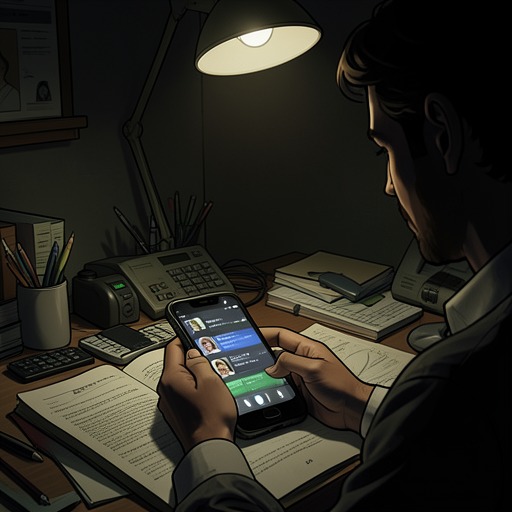
Andrew reads the posts as an investigator as well as a grieving community’s audience. The messages are unguarded and confessional, and he sees that their apparent intimacy has made the students less alert to who might read them. He begins thinking about a subpoena duces tecum to require Facebook to preserve the conversations. In his account, the web’s informality and its capacity to retain written exchanges pull in opposite directions: a space experienced by students as personal can also create a record for prosecutors to inspect.
Posts, accusation, and competing interpretations
The group’s discussion includes signs of the students’ proximity to the aftermath. One post reports that the writer is at Cold Spring Park, where yellow tape remains, but there is nothing to see and no police present. Another message tells Jacob to leave the discussion alone, says Ben considered him a friend, and insults him. Across the broader stream, classmates express shock, loyalty, anger, and grief in short, repetitive messages. Andrew scrolls through hundreds of them, looking for useful detail, but the sheer volume makes the stream difficult to interpret as evidence.
He eventually switches to Jacob’s own Facebook page, where discussion from the immediate aftermath of the murder is still active. A classmate warns that the accusation being circulated is gossip that could hurt people, even if intended as a joke, and tells Jacob to ignore it. Facebook thus holds disagreement about what online speech means: a post can be dismissed as a joke by one person, treated as dangerous gossip by another, and become part of the atmosphere of suspicion around Jacob. Andrew’s reading does not make the posts self-explanatory; their significance depends on context and on who is interpreting them.
The platform also draws Andrew back into the investigation through a personal confrontation with Sarah Groehl. When he asks why she directed him to Facebook, she denies doing so, though he presses her on the possibility that she had. The exchange underscores how the site’s contents have become central to his search for leads, while the motives of the people who might have pointed him toward them remain uncertain.
Jacob’s shrinking circle and online reinvention
After Facebook freezes Jacob’s account, apparently in response to a subpoena for everything he had posted, he opens another account under the name “Marvin Glasscock.” He begins adding people from his inner circle again, and Laurie argues that he needs the contact because he is alone. Andrew objects, but the parents agree on restrictions: Jacob cannot change the password, post anything touching on the case, or share photos and video. Their rules turn the account into a supervised compromise—some access to peers, with his father retaining the ability to monitor and edit what he says.
Andrew makes checking the account part of his morning routine. He goes first to Gmail, then Facebook, and then searches Google for Jacob’s name and news about the case. Jacob’s new online identity therefore becomes part of the household’s daily vigilance. Andrew describes a cat-and-mouse dynamic: Jacob tries to make jokes about his circumstances in terms vague enough to escape his father’s censorship. The platform offers a narrow opening for self-expression, but the same posts can be read as evidence or misread as signs of guilt.
The difference between online contact and social isolation is stark. Before Ben’s murder, Jacob’s Facebook network numbered 474, mostly classmates. Afterward, only four people accept “Marvin Glasscock,” one of them Derek Yoo. In person, Jacob has no friends, receives no calls or visits, and has been suspended from school; the town will have to arrange a tutor for him. Online, a handful of people still connect with him, but each exchange is recorded. Andrew reflects that digital conversation produces a transcript, a persistent archive unlike a phone call. Facebook’s recordkeeping is not merely a technical feature in the story: it changes what social contact can mean when a criminal case makes every message potentially consequential.
The Norman Bates image and the platform’s afterlife
In mid-August, Jacob posts a manipulated image based on Anthony Perkins in Psycho, with Jacob’s face placed over the figure holding a knife. He captions it “What people think of me.” His friends respond approvingly or jokingly, treating the image as an effective piece of internet humor. Andrew sees a different audience and a different future for it. He fears prosecutors could present the image to a jury as evidence of consciousness of guilt, encouraging jurors to connect Jacob with the film’s violent figure. The same image that Jacob’s friends receive as a joke can thus be recast in court as a statement about his identity.
Andrew carries the laptop upstairs intending to confront his sleeping son. He explains the risk: once an image is displayed to a jury, it may remain in jurors’ minds and influence them even if it proves little. His alarm is not simply about Jacob’s taste in jokes but about the mismatch between a casual post’s original setting and the serious interpretation it may acquire in court. Facebook allows the image to circulate beyond the context in which Jacob posted it, making the platform a route by which a private or playful self-presentation can become part of a public case.
After the trial ends, the family’s legal position and social standing remain out of step. Neighbors continue to associate Jacob with his knife, violent fantasies, and family history, and some regard the abrupt end of the trial with suspicion. The family does not send him back to school in Newton; he is homeschooled, and his isolation persists. Facebook’s earlier promise of a small circle of contacts does not undo that exclusion. In the novel, the platform’s record of grief, accusation, friendship, and self-presentation remains inseparable from the question of who gets to interpret a person—and what happens when an online image outlives the joke that produced it.